

In the United States — a country as sports-obsessed as any — Americans have little time or energy for anything new.
Professional and college football unite people with nothing more in common than the colors they cheer for. Basketball and baseball, some of America’s most popular exports, barely leave room at the table for hockey and soccer. Even beloved sports such as golf or volleyball struggle to compete for this valuable real estate.
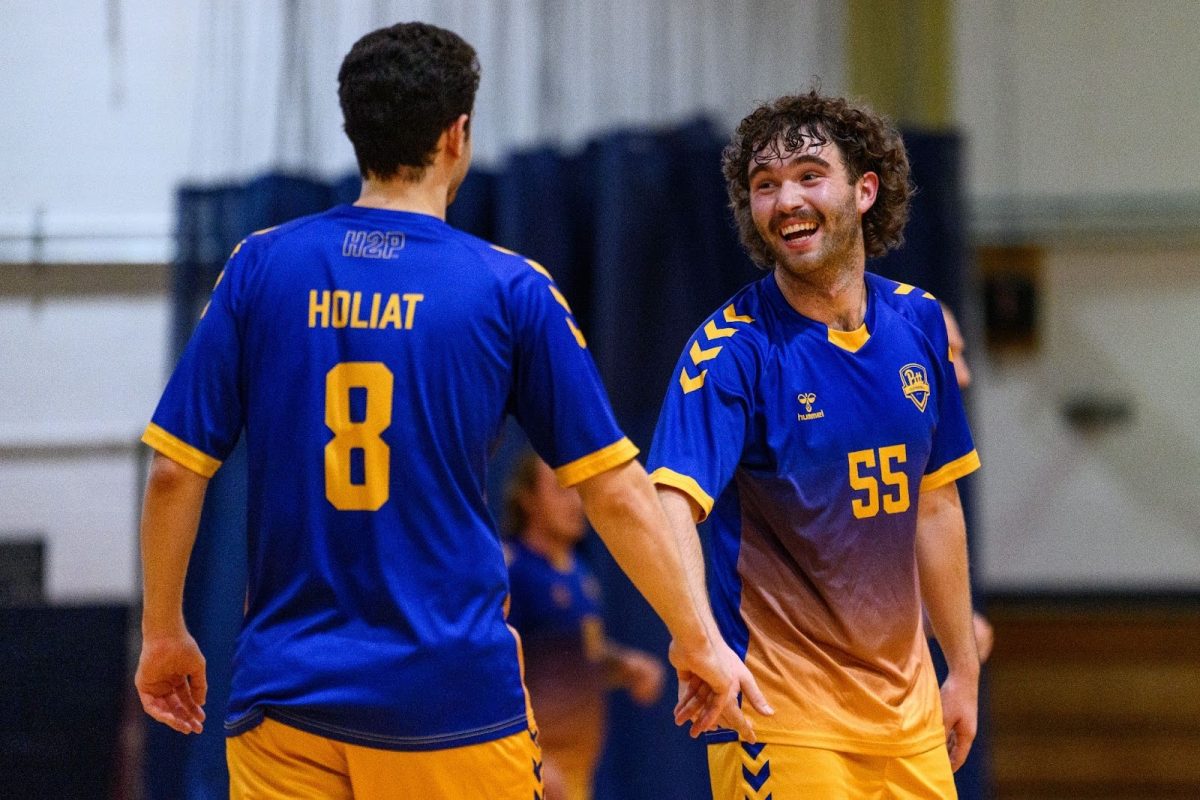
In the shadows are athletes tired of being overlooked and hungry for a seat at the table. Handball, a sport that the “vast majority of Americans are totally unaware even exists,” is attracting more and more of the United States’ best athletes — especially at Pitt.
Zachary Greenstein, a senior psychology student on the occupational therapy track at Pitt, is the vice president of Pitt Club Handball. From Silver Spring, Maryland, Greenstein arrived at Pitt just like most other Americans.
“I didn’t know handball really existed until I got to Pitt,” Greenstein said. “[Pitt Club Handball] happened to be right next to the Spikeball table. I was like, ‘Why not sign up?’”
Some Americans may remember playing handball in their high school gym class or a summer camp, but most are like Greenstein before attending Pitt and could use an explanation.
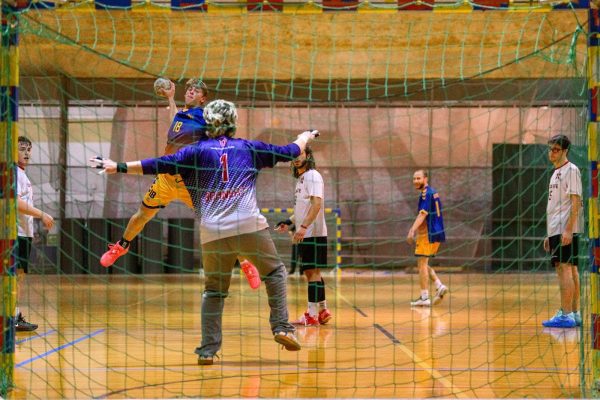
Handball is an indoor team sport played with seven players on each team. Six players are allowed to move anywhere in the court except for a 6-meter semi-circular zone containing a team’s goal, where only the goalkeeper can stand.
“[Handball] is like an above-ground water polo combined with lacrosse,” Greenstein said. “It’s a sport that bridges a lot of aspects that I think kids and Americans typically love in their sports. It’s got an incredible amount of contact. It’s got shots going 60-plus miles an hour. A ball is so sticky that if you stick it to your palm, facing down, it won’t come off your hand. It’s a sport that involves a lot of passing, movement and contact.”
Enforced similarly to basketball, players can only take three steps before they must continuously dribble the ball, shoot at the opponent’s net or pass to a teammate. The ball is 7 inches in diameter, making it just smaller than a volleyball, but it is built like a kids’ soccer ball. As Greenstein mentioned, resin — a sticky substance banned in other sports — is allowed, and, in handball, is actually discouraged to play without, allowing more creative attacks.
As a first-year, Greenstein played right wing, a position that touches the ball less, but was still Pitt Club Handball’s second-highest scorer. “I figured I was doing alright at that point when I was a freshman putting up six or seven points a game.”
Considering his production, Greenstein moved to right back, a “much more involved position”.
Through his excellent play in the college circuit and adult leagues over summer breaks, the idea of playing at a higher level became more real. When competing in the North American Qualifier for the IHF Club World Championships in New Jersey, Greenstein met players for HV KRAS/Volendam, a professional handball club in the Netherlands. The connections opened the door for Greenstein to take a semester abroad and play for HV KRAS/Volendam, one of the Netherlands’ best handball clubs.
(Alex Jurkuta | Contributing Editor)
Representing the United States in handball
Mark Ortega worked with HV KRAS/Volendam from 2020 to 2022 and helped Greenstein connect with the professional club. Ortega, who played for Team USA Handball for 11 years, has recently accepted a position as the head coach and program director of Team USA Handball.
“Zac really wants to succeed,” Ortega said. “He has the one-way ticket mentality. Like, ‘I have to go, and this is what I need to do to succeed. So I’ll just buy a ticket,’ you know, and then you go, and you figure it out. With handball in the United States, you sometimes have to have a one-way mentality.”
It’s a mentality that Ortega himself had when he first got involved with handball. After finishing a college football career at Kent State, Ortega wanted to compete for his country as an Olympic athlete. Handball was the sport that could make that dream happen. Now, Ortega is trying to help others achieve the same.
“The handball world is small,” Ortega said. “You go to one event, you meet a lot of people, and then you hear people who want to go on to the next level. You see players pretty quickly. So if you’re a coach in the United States, and you see something, I feel like I have an obligation to tell a junior national team coach or a senior national team coach.”
Greenstein is one of those athletes. If everything goes according to plan, Greenstein will compete with Ortega’s national team in the 2028 Olympics held in Los Angeles. Considering the United States is the host country, Team USA Handball will automatically qualify.
Greenstein isn’t playing in Europe for no reason. For an American player, playing overseas is practically a prerequisite to gaining respect in the handball community.
“My favorite part about being here is that I don’t have to explain what I’m doing here when I say I’m here for handball,” Greenstein said.
If Greenstein wants to accomplish his goal of playing for Team USA and competing in the 2028 Olympics, he’ll have to test his mettle against opponents who’ve played handball their entire lives. He recently spent a week competing in Denmark at a Team USA camp.
“Unfortunately, the American circuit at the adult level is just not quite high-level enough yet for [Team USA] to take you,” Greenstein said. “They won’t take these kids who are playing in college to play at these U21 or U24 tournaments with the justification that they’re not playing against good enough people.”
Greenstein’s frustration stems from a desire for American handball to improve — a sentiment shared by many in the community.
Kahlil Liden, a junior social studies education major, is the president of Pitt Club Handball. Growing up in St. Paul, Minnesota, Liden had watched handball during the 2016 Olympics. Unfortunately, there was no youth league for Liden to learn and start playing.
“There were only adult leagues,” Liden said. “When I was walking around the club fair, my choices were club football or club handball. I wanted to try something new, and fell in love with [handball] instantly.”
Liden played basketball, baseball, football and volleyball in high school — experiences that’ve helped him excel in handball.
“I would say Kahlil — first off, he just got done with the junior national team — he has a style that kind of looks like a European style,” Ortega said.

(Alex Jurkuta | Contributing Editor)
Bringing European strategy to America
Liden and other players with overseas experience have helped merge their American teammates’ multi-sport skills with high-level handball strategy, turning Pitt Club Handball into a well-oiled machine.
“A lot of the guys we get in our club are a lot of former baseball players, a lot of dudes who played basketball in the past, even if it wasn’t at a high level. We look for somebody who really knows how to throw and can throw from different arm angles and all that. We have a lot of guys with lacrosse builds — a good mix between athleticism and physicality.”
According to Liden, physicality is Pitt Club Handball’s calling card. The recently founded club, which is playing with a coach for the first time this season, brings a “uniquely American brand of handball.”
“We have a lot of guys who played football, so our defense is much more physical than other teams,” Liden said. “We end up getting ourselves in trouble sometimes.”
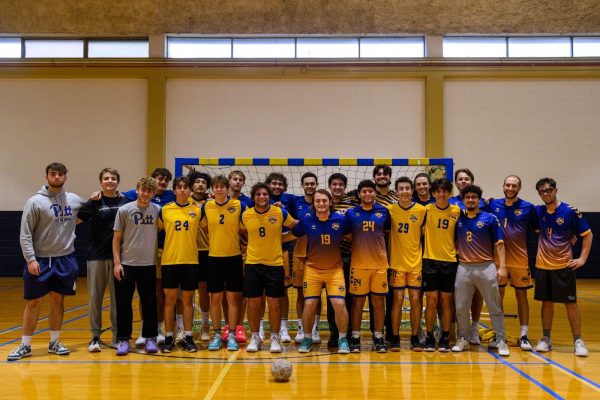
This style of play is all the Panthers know. The founders of Pitt Club Handball taught themselves how to play — and it worked. In Liden’s first year with the club, the Panthers traveled to North Carolina and won a national championship in the second division against James Madison.
Similar to Greenstein, the immediate success in a sport he’d never played before brought Liden back for more. Now, he’s a member of Team USA’s junior national team. Liden and Team USA won a Bronze Medal in the Pan-American Games held in Paraguay during the summer of 2025. Earlier this year, Liden also competed in the North American qualifying tournament in Mexico City and the IHF World Championships in Poland.
Greenstein and Liden’s professional experience against the best in the world and the Panthers’ ability to compete against perennial handball powerhouses such as North Carolina, Ohio State and West Point have opened their eyes to what’s possible in a sport they’ve so recently learned.
“Ever since I was a kid, I’ve wanted to play professional sports,” Liden said. “I didn’t think it would be handball, but, you know, it would be a real dream to make that happen. This sport has combined all of my best athletic attributes and has really put it into something that I think I’m very good at.”
Handball is what so many young American athletes, just like Greenstein and Liden, were looking for — an opportunity.
(Alex Jurkuta | Contributing Editor)
Helping make it happen through handball
No one believes that more than JD Orr. During the day, Orr is a validation engineer at Hikma Pharmaceuticals. At night, Orr works tirelessly to build and support handball at all levels.
Orr got into handball in elementary school as a summertime activity. When he arrived at Ohio State and saw handball in the 2012 Olympics, he wondered, “Why does Ohio State not have a team?”
“I got my buddies together, and we founded the team,” Orr said. “The captain of the U.S. national team, Mark Ortega, had just retired from playing and moved back to Columbus. He became our coach. So, in a matter of weeks, we went from never really thinking this was a real thing to having an official coach who’s with the national team.”
Now Orr, who currently coaches Ohio State men’s and women’s club teams, is paying it forward, giving out a scholarship taken out of his paycheck to college students starting a club team at their school. In the past, Greenstein and Liden would travel to Columbus to stay in Orr’s basement two nights a month to compete for a U.S.-based U24 select team that Ortega had started.
In the past, Orr has served on USA Handball’s board of directors, the national governing body for the sport. Recently, he founded an adult club team in the Columbus area, the Columbus Armada, and founded a nonprofit, the Great Lakes Team Handball Association.
“I would say [handball is] my passion project,” Orr said. “I’m not in it for the money. What I sell people on is — think about it — the key sports in America … None of those sports are at the fledgling level that handball is at. You could be the Paul Brown, the James Naismith, the Vince Lombardi, just because there is nothing.”
While increasing interest and participation at the collegiate level is important, American handball’s future success is dependent on kids playing handball throughout their lives, just like any other major sport.
“The whole youth infrastructure needs to be constructed,” Orr said. “Right now, even if I get a bunch of second graders playing handball, we don’t have middle school handball. So they’re not playing again. We don’t have high school handball, so they’re not going to play again.”
At the lower levels, there are just too many hoops for one man to jump through. Even if Orr can’t fix everything himself, he knows where the issues are.
There are only a few handball referees, and their union enforces specific payment and accommodation that would charge a tournament organizer thousands of dollars just for a single-day event.
The area of a handball court is more than double a high school basketball court. Because of the lack of popularity of the sport, it’s very rare to find a gym space big enough, and there’s little financial incentive to build one. The issue is so damaging to the growth of handball that Orr is devising a variant of handball that is playable on a high school basketball court with only five players on the court for each team.
“I’ve looked into building my own facility,” Orr said. “The cost is about $10 million. I do not have $10 million.”
The most limiting factor to handball’s growth is the lack of accidental exposure — handball games on TV, streaming and social media. The games that are aired are on ESPN3, a channel only accessible through a cable subscription.
“The bars can’t show [handball]. So I’ll take a laptop with an HDMI port and have the bar put it on that way,” Orr said. “That way, the games are on somewhere in a public place, and people can accidentally be like, ‘Oh, what’s this?’”
Along with preparing for several global competitions, Ortega is working on creating a “pipeline” to recognize high-level athletes, train them full-time at Team USA’s facility in Florida and take them to Europe to compete, gain experience and allow European professional clubs to see their play.
But that’s not all. The opportunities people like Orr and Ortega have to grow handball are endless. All it takes to take advantage of those opportunities is more people pulling in the same direction.
“Anyone playing in college who has a team is doing a good job,” Ortega said. “Every college helps and gets hands involved.”
Pitt Club Handball is a microcosm of the opportunity the sport presents. For players like Greenstein and Liden, handball is a stage to chase dreams. For others, handball is a passion they never knew existed. All it takes to find it? Just getting involved.
