

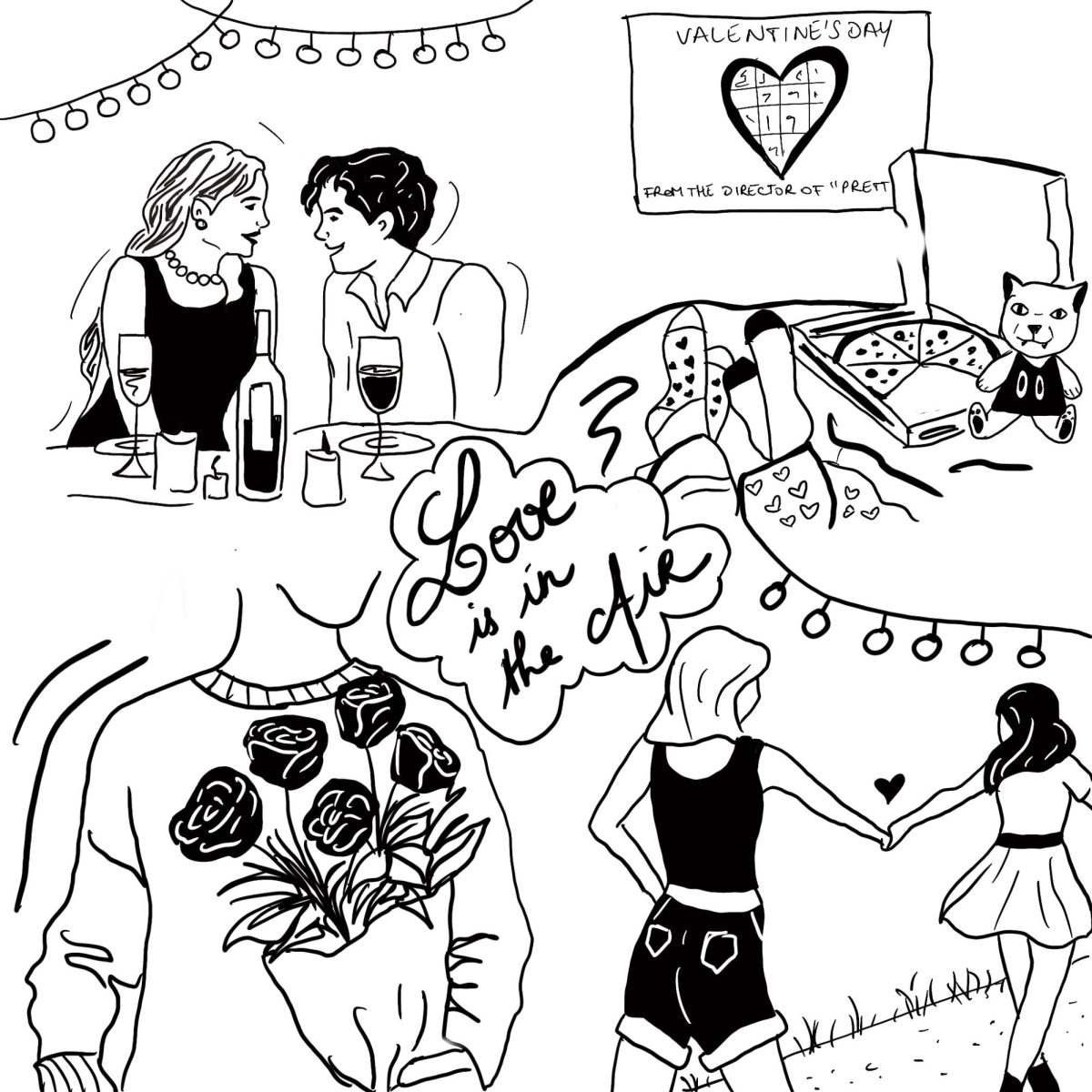
With Valentine’s Day approaching, love is in the air. Whether you’re celebrating with a partner, honoring Galentine’s Day or treating yourself, it’s time to celebrate love — a feeling society claims to understand but rarely respects. After recently celebrating my second anniversary with my boyfriend, I’ve found myself reflecting a lot on love. Love has long held a tender importance in humanity, yet it is consistently reduced to its shallowest parts. It’s dismissed as weak, emotional or indulgent. In reality, love is one of the most powerful forces we experience — and it is inherently feminist.
The media and pop culture in general has branded love as a “girl thing.” Through sappy rom-coms that are never taken seriously and female characters being whittled down to only a love interest, love is demoted to being romance centered, heteronormative and a prize for men to gain and women to provide.These stories don’t just trivialize love — they equate femininity itself with dependence and fragility. To counter that, in an attempt to be more “feminist,” the media started to push the hyper-independent “girlboss” trope in the 2010s. The girlboss doesn’t want love nor connection and measures empowerment solely through career success. Rather than dismantling misogyny, this trope reinforces it. Suggesting that love is feminine and therefore incompatible with strength is one of the least feminist arguments imaginable.
Even in more recent media, this trope is still being used as a way to empower women characters without actually understanding the complexities of what a woman can be. For example, in the final “Stranger Things” season, the writers justified breaking up a long-standing relationship between the characters Jonathan and Nancy because “Nancy obviously has proven to be much more independent” than being in a relationship. The implication is familiar and frustrating — a woman cannot be driven, ambitious or self-actualized while also loving someone. Its narrative is equating independence with emotional isolation, as if connection is a liability rather than a choice.
As a woman who is in a long-standing relationship, this narrative rings hollow. Having the blessing of loving my boyfriend did not strip me of my independence — it strengthened it. Before our relationship, I struggled deeply with self-confidence and finding my voice. Falling in love with someone who valued me did not solve those issues for me, but it did give me the safety and encouragement to begin the journey of growth. Independence doesn’t mean being alone. Growth does not happen in a vacuum. While self-work is personal, it is often nurtured through community, care and connection. Love, whether it’s romantic, platonic or familial, has the capacity to deepen our understanding of ourselves and find our voice.
At its core, love is not passive. It demands vulnerability, accountability and intention. It motivates people to create, protect and challenge the world around them. My love for film and storytelling is what drives me to pursue a career in an industry that rarely guarantees stability. Choosing that path is an act of rebellion against expectation, just as choosing love on one’s own terms is a rebellion against a culture that devalues it. Feminism is not solely about equality in numbers or opportunity, it’s about reclaiming autonomy in every form.
Love has always fueled progress and is at the center of everything. The love women have for one another, for their futures outside of being in domestic confinement, is what made liberation from men possible in the first place. To love people, your passions and all in between, is not a weakness. It is a refusal to be hardened by systems that benefit from emotional detachment. This Valentine’s Day, celebrate love to the fullest, as it is a recognition of the strength it takes to care deeply in a world that insists you shouldn’t.
Heidi likes to write about film, pop culture and all things spooky. Email her at [email protected].