

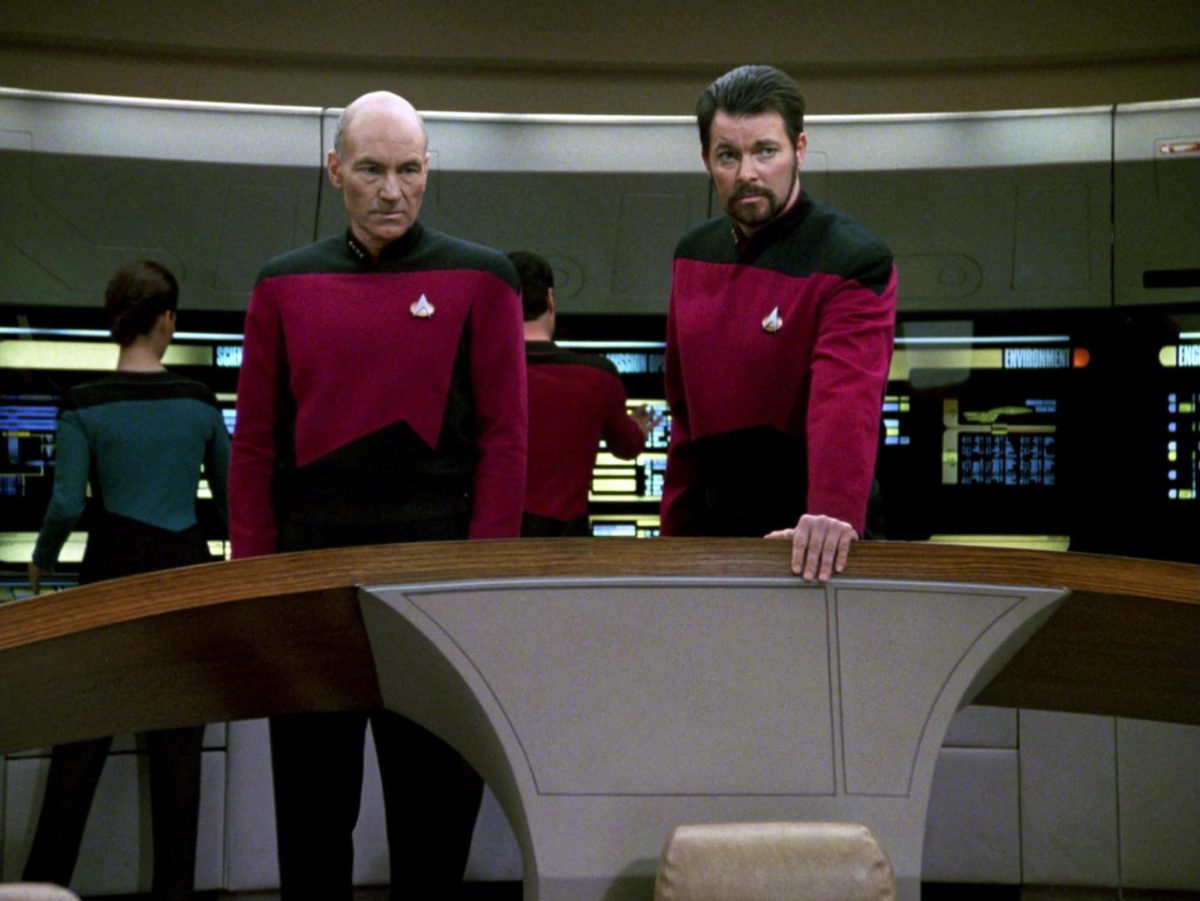
The Cold War shaped the early decades of “Star Trek,” specifically its vision for a not-so-distant 21st-century future. Now, a quarter of the way into the real 21st century, the threat of a second Cold — or even hot — World War hangs uncomfortably close over our everyday life. Interestingly enough, the creator of “Star Trek,” Gene Roddenberry, predicted a Third World War that would begin this year — 2026.
With this baseline threat of nuclear war happening during both “Star Trek: The Original Series” and “Star Trek: The Next Generation”’s run time, Roddenberry likely wanted to portray an uplifting future in his stories. In fact, a defining component of “Star Trek”’s storytelling is its unwavering hope for the future of mankind. However, the near future — the 21st century — incorporated the idea that the state of the world would get worse before it got better. As a result, the 21st-century timeline throughout the “Star Trek” canon is riddled with heavy division, global war and human-onset climate change. Roddenberry believed that the planet had to hit rock bottom before it could reach the idyllic future seen in its primary canon during the 23rd century.
Many “Star Trek” fans, including myself, have taken interest in the accuracy of the show’s ideas for how this century will play out. Will we be able to reach a utopian global peace by 2100, and, if so, will the only road to that world be one of suffering?
Just as a preface — this article won’t go in depth on “Star Trek”’s Eugenics Wars of the 1990s or on Khan Noonien Singh’s character arc, but instead will primarily focus on the events occurring in the 21st century — sorry to all my fellow Trekkies out there. I’m also ignoring the timeline shifts brought about in recent “Star Trek” media — specifically “Strange New Worlds”— as their additions complicate the 21st century timeline. However, I think these events and people are important to note as background knowledge for the projected 21st century.
The Earth Eugenics Wars occurred from 1992 to1996 and left the planet fairly devastated by the end of the 20th century. They are also partially responsible for the subsequent tensions in World War III. Governments struggled to provide necessary aid at the beginning of the 21st century and by 2024, global economic inequality had reached such a dire level that the Bell Riots occurred in San Francisco, California. These riots are the most notable examples of unrest prior to World War III, and the war itself begins just two years later in 2026, lasting until 2053. The war’s reported death toll was 600 million, which left Earth’s remaining inhabitants in desperate need of unity. It’s in the following few years that all humans united cross-continentally out of necessity and began the long process of rebuilding.
The cause of all this war and unrest is left fairly vague – the divisions themselves, however, are clear. Economic and social prejudice run very deep in this fictional society, as they do in our real society, causing deeply divided and violent class conflict. The origins of the conflict can be attributed partially to the Eugenics Wars. However, when keeping the Cold War in mind, it’s more evident how those conflicts may have been a metaphor for national identity and pride. With this type of pride and disdain for other national identities with “opposite” ideals and morals occurring in real life — such as the USA vs. USSR — the existence of Augments, genetically modified humans, seems like an immoral, un-American sect of people. Their existence is likely a comment on the Soviet Doping Program of the late 20th century more than anything.
The current United States administration is known for promoting a hyper-patriotic version of so-called Americanism that puts down any country not fully aligned with ours. When this type of belief becomes mainstream, it makes anyone who isn’t exactly like you the “enemy.” It can even lead to paranoia within your own country’s borders, which turns neighbors and community members against each other. Lack of resources, from financial to safety to food, creates an obligation for the government to aid its people. “Star Trek”’s 21st-century America is run by a government that never fulfilled that obligation, and that failed their population.
The inherent fear of the other— primarily fear of “other” people in different social circumstances who need either aid or protection from those in power— perpetuates every dysfunctional aspect of society: it leaves homeless people lost in a broken system, it ousts them from the rest of society, and it turns the rich into celebrity-level “gods.” Those without documentation on them at all times get detained by law enforcement, and anyone who even gets close to breaking a law is penalized. A lot of this sounds a bit too familiar.
In the “Star Trek” universe, humans do eventually get it right. Through United Earth — all countries that survived World War III — UESPA, the United Earth Space Probe Agency, was founded. This was an agency that continued space exploration in the name of finding a less-polluted planet for humans to live on. People also focused more time on cleaning up Earth’s atmosphere and by the early 22nd century, war, poverty, disease and hunger were supposedly eliminated from the planet. From there, humans were able to thrive the way they do in each primary piece of “Star Trek” media.
I firmly believe that there has to be a relatively peaceful path to this idyllic world. I’m an optimist, so maybe that’s why I’m convinced, but humanity has proven time and time again that we can pull ourselves out of dark, global conflict within a mere few decades. If we fall into major conflict in the next few years, it hopefully won’t take half a century for us to come to our senses. It might be easy to spiral into that thought when looking at the current state of the world, but I think we still have it in us to change our trajectory before it’s too late.
If there’s any hope of saving this planet by the end of the century, we must take a step back and focus on what moves will set us up for a future of longevity and happiness. We can gain a lot from examining media like “Star Trek” — not just to one day reach a similar utopian society, but also to guide ourselves with the optimism found throughout its canon. “Star Trek” holds up 60 years down the line because it is one of the most optimistic outlooks on the future and puts unwavering faith in humanity to pick itself up after difficulties. It’s very easy to be negative these days with everything happening in the world, and even “Star Trek” predicted mass unrest and trouble for this period of time. If humanity keeps going, though, and takes the time to unite amongst itself, then I believe we’ll not only be able to avoid major disasters, but we’ll also be able to push ourselves forward, regardless of what gets in our way.
Isabel Hoch is a sophomore English Writing major who obsesses over very specific things for months at a time. If she writes an article about something, it means her friends haven’t heard her shut up about it in weeks. To get in a heated debate over something dumb (or chat with her about your favorite Star Trek characters), you can email her at [email protected] .