

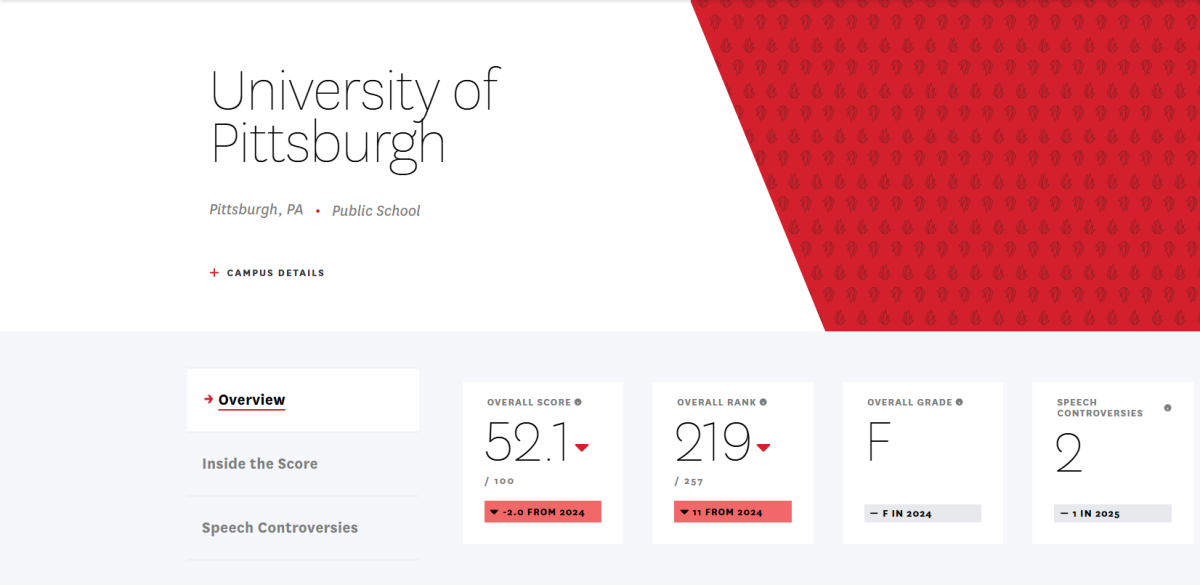
This month, Pitt scored its lowest ranking to date in the Foundation for Individual Rights and Expression’s sixth annual free speech report.
Pitt received a “failing grade” for campus free speech — ranking 219 out of 257 schools in the FIRE’s 2026 College Free Speech Rankings and scoring 52.1/100 overall.
The University defended its free speech record in a statement, saying it “has a strong record of supporting free speech for its students, faculty and staff and encouraging constructive conversations and the free exchange of ideas.”
According to FIRE, the College Free Speech Rankings evaluate schools based on student surveys, campus policies and recent speech controversies.
The overall score, designed to assess the state of free expression on campus, is made up of twelve components. Six graded categories — Comfort Expressing Ideas, Disruptive Conduct, Openness, Self-Censorship, Administrative Support and Political Tolerance — measure “how students feel about free speech on campus” through 358 survey responses. The remaining components track incidents like deplatformings, scholars under fire and students facing disciplinary action for speech, along with policy evaluations through FIRE’s Spotlight database rating system.
This year, Pitt earned a yellow rating through FIRE’s Spotlight database, which indicates that a university restricts limited amounts of protected expression or maintains policies with vague wording that could be misused to suppress free speech.
Schools also receive points for adopting free speech commitments like the Chicago Statement — which affirms a university’s dedication to open discourse — and institutional neutrality policies.
Since FIRE’s 2024 report, Pitt improved in Disruptive Conduct, Openness and Political Tolerance. However, Pitt has decreased to an “F” score in Comfort Expressing Ideas and Administrative Support — two categories that evaluate how effectively the University protects and facilitates student expression.
Pitt’s ranking dropped 11 places from 2024, in part due to penalties for “speech controversies” involving Pitt’s chapter of Students for Justice in Palestine — a December 2024 “library study-in” that was shut down by University officials and the organization’s suspension last spring.
According to FIRE’s report, at the December “study-in,” students wearing keffiyehs and surrounded by Palestinian flags participated in a study session while displaying messages like “free Palestine,” “no universities left in Gaza” and “429 days of genocide” on their laptop screens. The FIRE report stated that library administrators told students their presence had “modified” the space, requiring them to leave and provide identification for student conduct referrals.
Though SJP denied organizing the study-in, the University placed the organization on interim suspension following a disciplinary process that lasted until August, when a federal judge granted a preliminary injunction.
In its 2026 report, FIRE defined speech controversies as “campus incidents where a student, professor or speaker faces backlash or pressure for speech that is protected by the First Amendment or academic freedom.”
The FIRE report also cited the cancellation of congressional candidate Bhavini Patel‘s speaking event in February 2024 as a “deplatforming” that affected Pitt’s score. Patel, a Pitt alumna who supports Israel, was scheduled to speak about her experience as a Pitt alumna when the event was cancelled a day prior.
According to FIRE, the University cited a policy barring “political campaign activities” as well as safety concerns when cancelling the Bhavini Patel event.
The FIRE report said Pitt could make “immediate strides” by implementing new speech policies to earn a green light Spotlight rating, along with “an official commitment to institutional neutrality.”